Question
How do you connect brand strategy from insight to activation?
Work
Brand strategy, narrative architecture, audience modeling, segmentation and workflow design.
My time in agencies shaped how I think about brand strategy. The work brings together what a client believes, what a product can deliver and what matters to the people it hopes to reach.
Those connections have to carry into the campaign, the language and the decisions about where to focus. Each new piece of work needs to develop the same underlying idea.
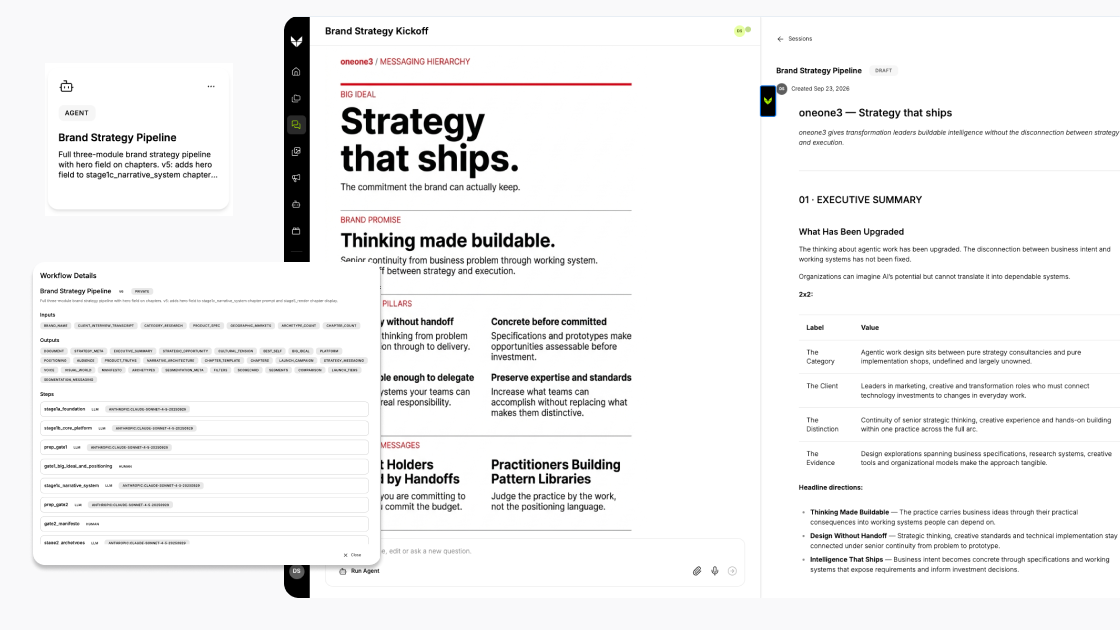
I designed a brand strategy workflow to explore how agents could help maintain those connections, from the source material through positioning, narrative and audience priorities.
Begin with the material behind the idea
The workflow starts with a client interview, category and competitor research, a product specification and the markets the brand wants to reach.
Client input and research are identified separately. An ambition expressed in an interview is different from something the product can demonstrate or a pattern observed in the market.
Keeping those distinctions visible gives the team a basis for examining the strategic opportunity. What can the brand credibly offer? Which tension could it resolve? What deserves further investigation?
Give the strategy a form people can use
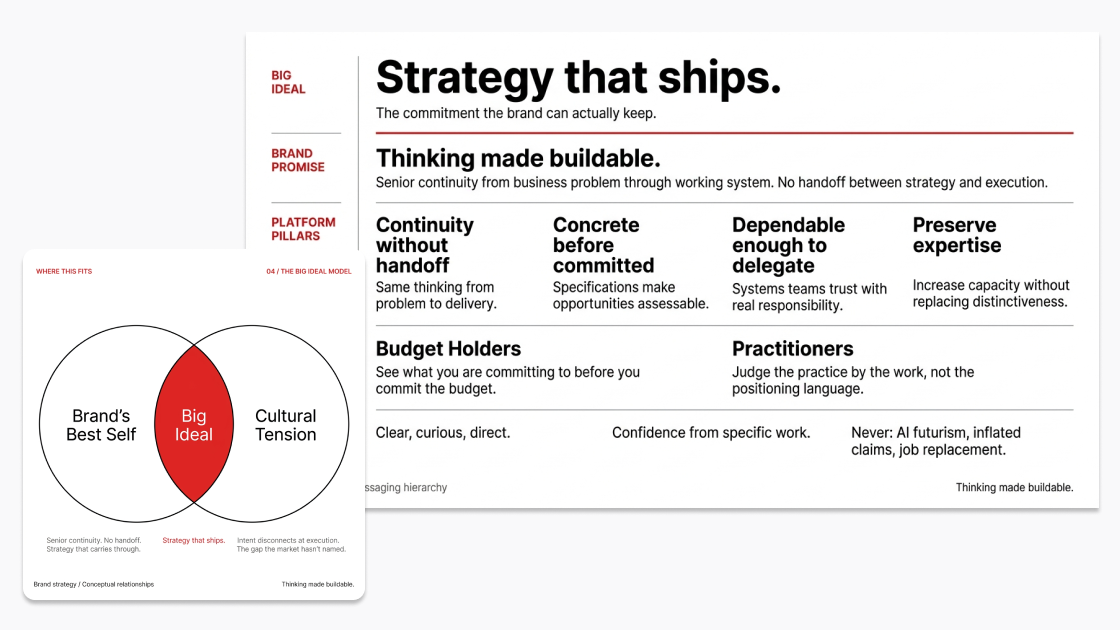
The first module develops the brand’s central belief, positioning, audience and supporting product truths.
That direction feeds a narrative system: messaging pillars, story chapters, campaign ideas, voice and visual guidance. The chapters provide a repeatable way to develop different stories around the same strategic idea.
The design makes the relationship between those outputs explicit. Later stages receive the thinking developed earlier, giving the team an argument it can follow, question and refine.
That creates a practical way to examine whether the campaign expresses the positioning and whether the positioning is supported by the product.
Turn audience understanding into choices
The second module proposes behavioral archetypes: patterns that could help explain what different people value and how they make decisions.
The third combines those archetypes with the strategy to propose market segments, priorities, launch tiers and messages for each group.
This moves the work toward choices a team needs to make. Who should the brand focus on first? Which benefits matter to them? How should the launch unfold?
The generated audiences remain hypotheses. Their value needs to be tested against client knowledge and evidence of real behavior.
Give the team clear moments to decide
The workflow defines review points for the central belief and positioning, the manifesto and final authorization.
These moments bring attention to decisions that shape the work that follows. Is the proposed belief meaningful? Is the promise credible? Does the language give the brand a distinctive way to express it?
The exploration makes those decisions and their dependencies easier to inspect. My aim is to give strategy teams more room to develop alternatives and test the thinking that connects them.