Question
How do you turn a business idea into something you can build?
Work
Business specification and product definition.
Early in a business, a customer conversation can change the offer. Market feedback can shift the audience. A technical finding can change what is practical to build first.
Keeping everyone working from the same understanding takes effort, especially when the thinking lives across presentations, spreadsheets and documents.
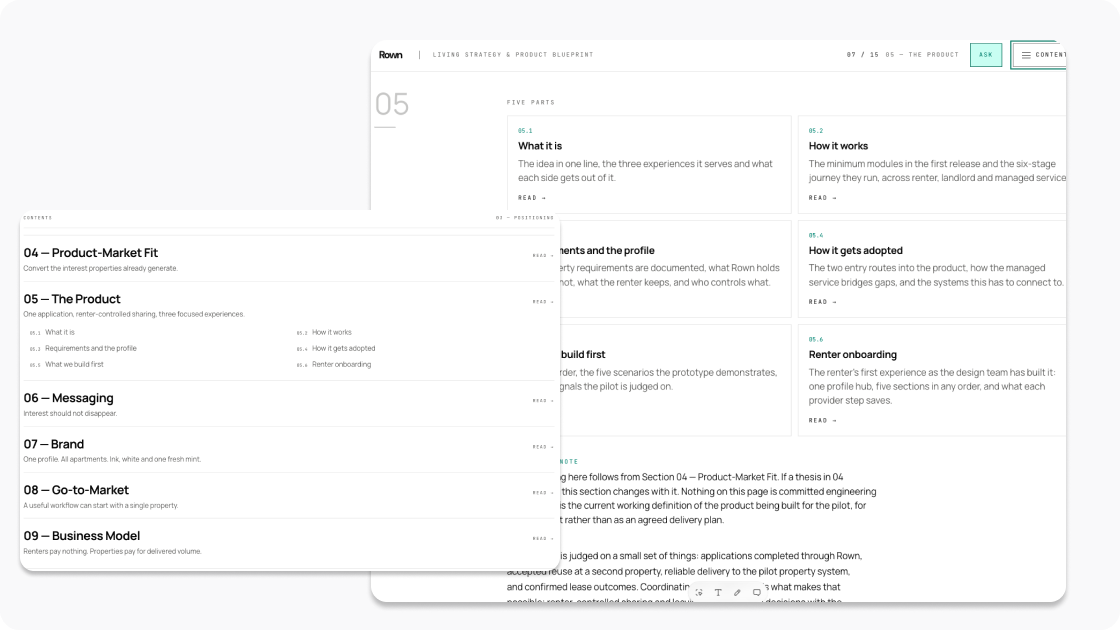
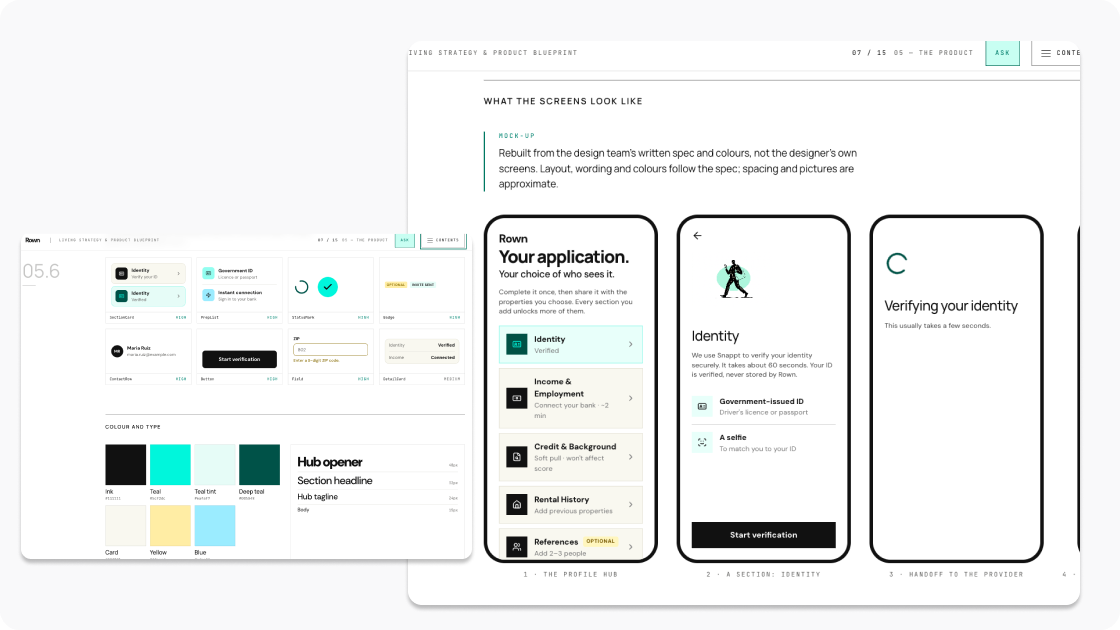
For ROWN, I’m building a shared business specification that develops alongside the idea. It brings the customer promise, commercial model and product requirements together, giving people and agents a common starting point for their work.
Give the business a shared definition
ROWN connects the renter’s application experience with the property’s leasing workflow. Defining that business means working through who it serves, what it promises and how it will deliver.
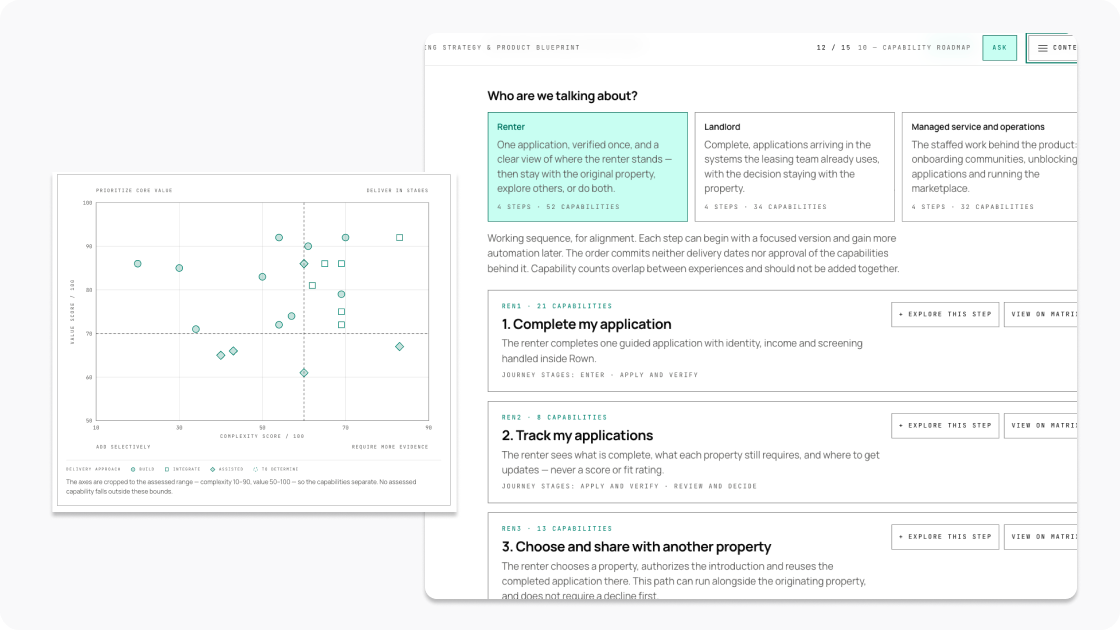
The specification brings those questions into one place. People can explore the product definition, audiences and priorities, and see which decisions have been made and which assumptions still need testing.
The design gives a changing idea enough structure for other people to understand it, question it and start building from it.
Make the consequences of a decision clearer
The relationships between decisions matter as much as the decisions themselves.
One commercial hypothesis is that renters pay no application fee and properties pay a success fee when a lease is executed. That choice affects the product: the service needs a way to confirm the outcome being paid for, alongside an application experience that renters and properties will use.
An integration finding can have similar consequences. It may change the first release, the operating process and what the business can promise.
Working through those relationships together helps the team assess a decision in the context of the whole business.
Bring that understanding into the next piece of work
A person developing a feature and someone preparing sales material need different details, but they should be working from the same business definition.
Teams and agents can retrieve the specification through connected tools such as ChatGPT, Claude and Claude Code. They can use the current requirements, positioning and constraints while creating a prototype, campaign or product brief.
That makes the specification useful beyond its own interface. The thinking behind the business becomes available where the work happens.
Keep learning connected to the direction
Customer feedback, market validation and technical findings give the team reasons to revise the specification. Agreed decisions and untested assumptions remain distinguishable.
When the direction changes, the team can revisit the product choices and materials affected by it. Existing outputs still need review; making current context available is one part of keeping the wider body of work aligned.
The aim is to make each iteration easier to build on, with a shared understanding that develops as the business learns.