

Question
How do you scale personalization with the team you already have?
Work
Product design, prototyping and experimentation with shared context, AI generation and human review.
Every additional resort, guest type and moment in a journey creates another communication to prepare and maintain.
For Sandals, that means keeping property facts accurate, deciding what each message should accomplish and adapting it for the guest receiving it. As the program grows, so does the work of creating, checking and updating it.
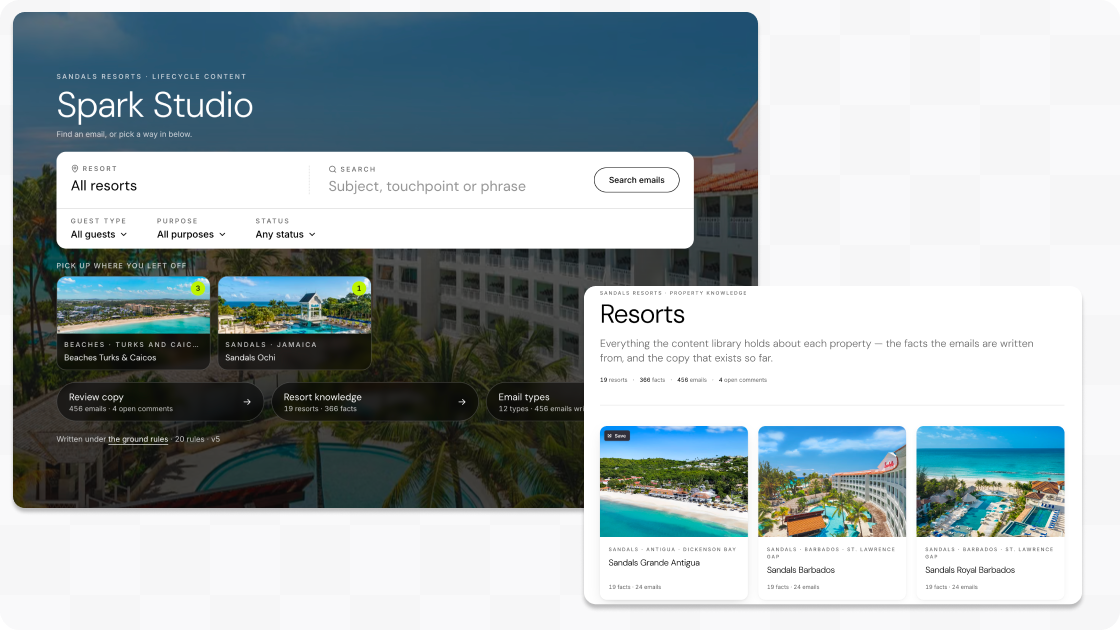
I designed and prototyped Spark Studio to explore how the existing team could manage a more personal, responsive email program.
Give each message the context it needs
I started by organizing the information behind the communication.
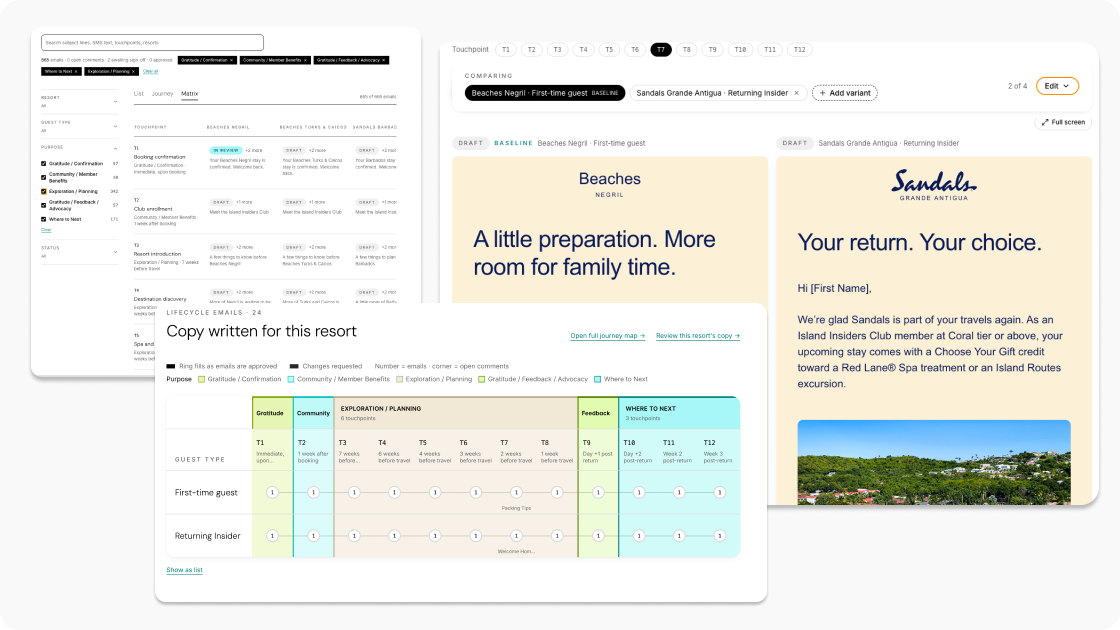
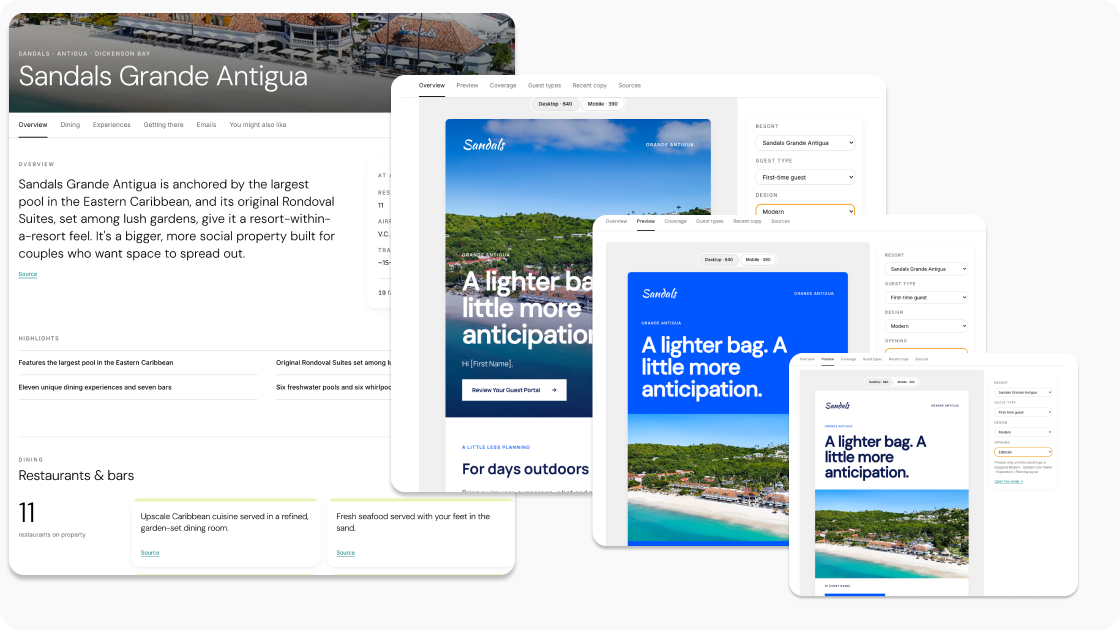
The resort supplies the facts. The journey stage gives the message a purpose. The guest type shapes what needs emphasis. Creative references and authoring rules guide how it should sound.
Sanity holds those inputs in a shared structure. That gives generation a consistent foundation and gives the team a place to maintain the information independently of any single email.
The design question becomes specific: for this resort, this guest and this moment, what should the message draw on?
Make creation and review one process
ChatGPT uses that context to create and revise content. The work returns to Sanity, where versions and relationships to source material are retained.
Spark Studio gives the team a place to inspect the emails, comment, refine and approve them. The review experience is part of the product from the beginning.
Connecting those steps means an email can remain attached to the information and decisions behind it. Someone returning to a draft can continue the work with its context available.
That continuity matters when the task is maintaining a whole program over time.
Put enough work through it to learn
The exploration produced 456 emails across resorts, journey stages and guest types.
That breadth made the design questions concrete. How should context guide a variation? What does a reviewer need to see? How should revisions be retained? How does the team find and return to existing work?
It also created a foundation for exploring alternatives. With the underlying information organized, the team can investigate different messages and more specific guest needs.
The same resort knowledge can inform further formats and interactions. The email prototype provides a place to understand what those extensions would require.
Turn additional capacity into better communication
The approach connects company context, generation and review, a combination also emphasized in OpenAI’s enterprise research. For Spark, the practical test is how much more of the program the existing team can maintain well.
Two further ideas help frame the potential value. Demand elasticity value: reducing the effort of each variation could make more audiences and experiments worth serving. This applies the demand-response argument to the design.
Compounding intelligence premium: corrections, approved examples and future performance findings could improve subsequent work when deliberately incorporated into shared guidance. This draws on my workflow-value framework.
The next step is connecting Salesforce delivery and performance feedback. That will help test which additional relevance improves engagement and bookings, and where the team should invest its capacity.